
Contents
Key points
- You can start with gear in a truck you already own for about $2,150: roughly $1,600 of equipment, a $50 business license, and $500 a year for insurance.
- The startup numbers online range from $600 to $20,495, and the difference is almost entirely the trailer. None of the published totals include buying a vehicle.
- The biggest totals come from companies that sell trailers. In one $15,695 package, $14,995 of it is the trailer.
- Skip the water tank in your first season. On a 4 gallon per minute setup you can hook straight to the customer's outdoor tap.
- Set a minimum job price on day one and raise it as your calendar fills. One operator went from $130 to $150 to $200.
The short answer on how to start a pressure washing business: buy a 4 gallon per minute gas machine and a surface cleaner, register the business, get liability insurance, and go find work. If you already own a truck, that runs about $2,150.
The confusing part is everything else you read. Published startup budgets for this trade run from $600 to $1,050 for a minimal setup up to $15,000 to $20,000. That is a thirty-fold spread for the same job. Below is what actually drives it, and it is not what most articles imply.
What the startup numbers really mean
Three real quotes exist for a working setup. Line them up and the pattern is obvious.
Gear in the truck you own, about $2,150
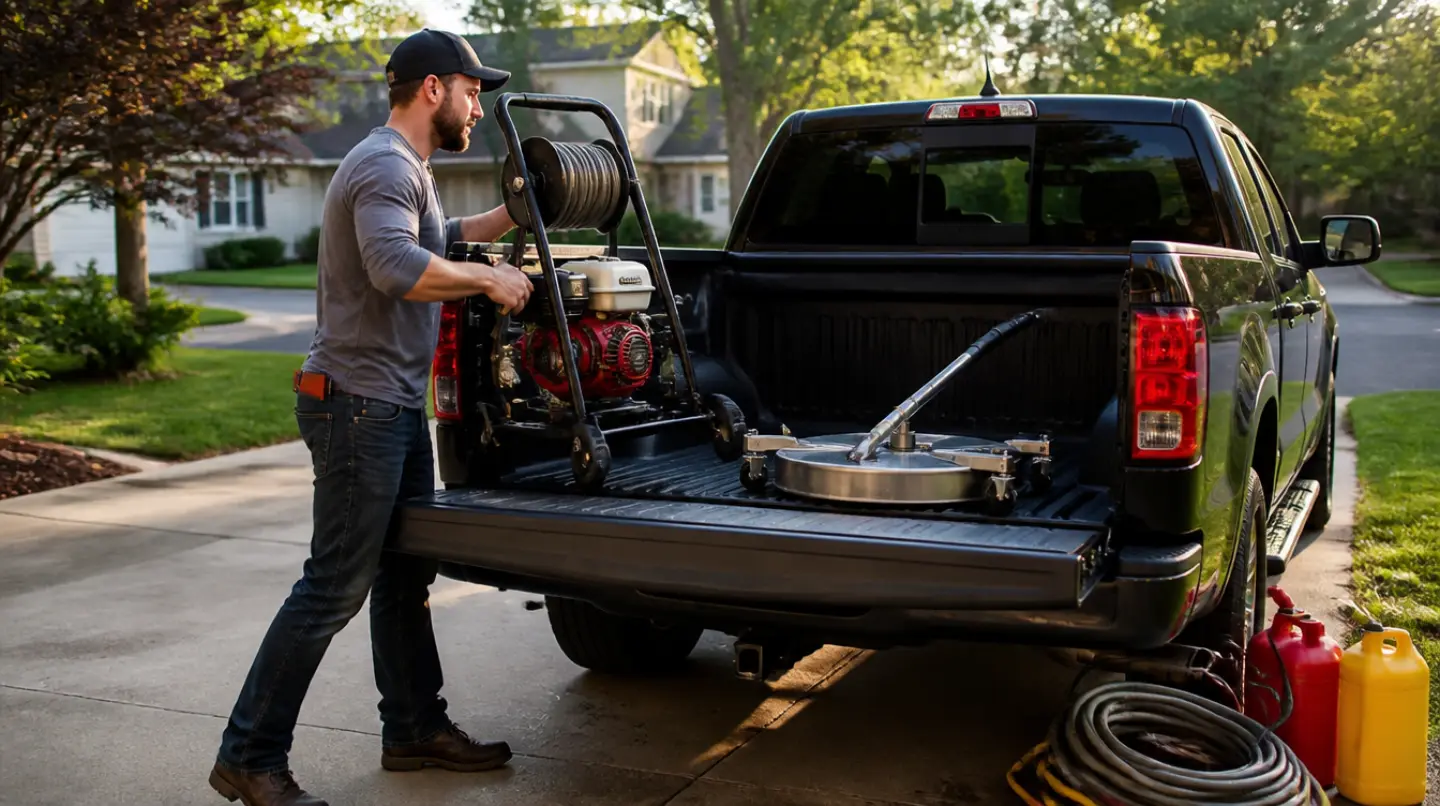
One operator posted his full kit at about $1,600, new or used: a 4 gallon per minute machine with a direct drive pump, a surface cleaner for concrete, hoses, reels, two gas cans, boots, eye and ear protection, and the j-rod and downstream injector you need for house washing. Add a $50 a year business license and about $500 a year for insurance and you are near $2,150. No trailer, no tank.
The same work on a cheap trailer, about $4,400
A trade forum carries a quote for a complete 4 by 8 trailer package at $3,895: a 13 horsepower Honda engine, 4 gallons per minute, a 225 gallon tank, a surface cleaner, a hose reel and 200 feet of hose. With the license and insurance that is about $4,400. What you buy is speed. The rig stays hooked up, so setup at each stop is minutes rather than unloading a truck bed.
A turnkey trailer, $15,695 to $20,495
Now the big numbers. A trailer manufacturer publishes a $15,695 residential setup and a $20,495 commercial setup. Read the line items and almost all of it is one product: $14,995 of the residential total is the trailer itself, and $18,995 of the commercial total is theirs. The rest is a hose, a surface cleaner and chemicals.
So the honest reconciliation is this. The spread in published startup costs is a trailer decision, and the largest figures are quoted by companies that sell trailers. Two things follow. None of these totals include buying a work vehicle, so add that yourself if you need one. And the $15,000 to $20,000 figure you see quoted elsewhere comes with no breakdown at all, so there is no way to check what it buys.
One more warning from the forum. Somebody there priced a water recovery system at $17,000 and was told plainly not to buy gear before he had jobs for it. Start at the tier your work justifies.
The machine, and what to spend on it
Machine prices sort by fuel type: electric runs $150 to $400, gas $300 to $800, and diesel $1,500 to $5,000, with a recommended gas minimum of 4,000 PSI and 4 gallons per minute. For paid work, gas is the floor. Electric machines are too slow to earn money on a driveway.
Gallons per minute matters more than pressure. Pressure cuts, flow rinses, and rinsing is most of the job. Around the machine you need nozzles and tips for different surfaces, a surface cleaner at $100 to $500, and detergents and degreasers at $20 to $70 a gallon. Water tanks run $100 to $1,000, which brings up the thing beginners get wrong most often.
You probably do not need a water tank
On the same forum thread, an operator answering someone buying a 4 gallon per minute setup put it simply: do not worry about tanks, hook the machine up to the customer's outdoor tap, and if you have a truck, throw everything in the back and run like that for a while. A tank is a buffer for high-flow rigs, not the main supply. Skipping it in your first season puts the money into a better machine instead.
Register the business, then get licensed and insured
Set the business up properly before the first job. That means three things: a legal structure, a tax ID, and a business bank account you keep separate from your own. The operator with real numbers recommends starting with an LLC, on the grounds that it is simple to set up and protects you far more than a sole proprietorship. Then get a local business license, reported at about $50 a year.
Liability insurance is not optional, because you are spraying water at somebody's house. Two published figures look like they clash. The forum quotes $500 or more a year for an annual policy. One operator pays $150 to $200 a month, or $20 to $30 a day, which is $1,800 to $2,400 across a year. Both are real. Buying by the month or the day costs more than an annual policy, and the day rate is a good way to get covered for your first few jobs before committing to a year. The $2,150 figure above uses the annual number.
Check your local rules on wash water too. Some places regulate where run-off is allowed to go and which cleaning products are allowed. Ask your city before your first commercial job, not after.
How to price your first jobs
This trade prices by the square foot of the house, not by the hour. One operator's formula is the home's square footage times 14 cents, so a 2,200 square foot house comes to $308. Published job prices back that up: $100 to $300 per residential service in one source, and an average house service of $192 to $400 in another.
Set a minimum on day one. The same operator started at $130, moved to $150, then to $200 once he got busy. A minimum is what stops a small job three towns over from costing you money. Our pressure washing pricing guide goes into rates by surface, and the free pressure washing estimate template does the per foot math when you write the quote.
Getting your first ten customers
Start with a Google Business Profile, filled in properly, because local searches are how most homeowners find a washer. Then yard signs. The operator with real numbers called signs at stop signs and red lights his best lead source, better than paid ads, which took a lot of time to get working. People stopped at a light have time to photograph your number. A sign on the vehicle does the same job. One operator's competitor washed a single house and got calls from the whole neighborhood off the sign on his trailer. Door hangers and word of mouth fill in from there.
Then the part that decides whether those leads become work. Wash calls come in while you are holding a wand, 30 feet from your phone, next to a running engine. Callers do not leave voicemails and wait. They dial the next name. An answering service built for pressure washing companies picks up in your business name, asks which surfaces and roughly how big, and books the job, so you get the square footage with the booking. EveryDial is $49 a month on Starter with 100 receptionist minutes included, or $149 on Pro with 400.
Your receptionist answers every call in your business name, asks what needs cleaning and how big it is, and books the job while you keep working.
Running the work, week to week
- Quote concrete from photos. Ask the caller to text pictures of the driveway, then price it. For a house wash, look the square footage up from the address.
- Promise a window, not an hour. Wash work moves with the weather, so give a morning or afternoon and confirm the day before.
- Text the customer the morning of the job. It cuts no-shows and locked gates.
- Never run the machine for more than a minute without water flowing through it, or you will fry the pump.
- Water any plants and grass around the area before you spray a chemical mix nearby.
Can you scale it? An honest answer
Not easily, and it depends on your weather. The operator with the real numbers said washing is hard to scale, and that climate matters more than effort. In mold and algae heavy regions houses need washing often and routes fill up. In drier places a house wash can be a once a year purchase, which caps what one neighborhood gives you. He used washing as a feeder into a lawn care business rather than trying to scale washing itself.
None of the vendor guides mention this, which makes sense, because they sell trailers and machines. When you are ready to put numbers on paper, our pressure washing business plan guide has a worked first-year projection and a break-even.
Frequently asked questions
How much does it cost to start a pressure wash business?
About $2,150 if you already own a truck: roughly $1,600 of gear, a $50 business license, and about $500 a year for insurance. Putting the same gear on a cheap 4 by 8 trailer with a tank was quoted at $3,895, or about $4,400 with the paperwork. The $15,695 and $20,495 totals you see are turnkey trailer packages where the trailer alone is $14,995 or $18,995, and none of these figures include buying a work vehicle.
Do I need a license to power wash?
In most places you need a local business license, which one operator reported at about $50 a year. Alongside that you want a legal structure, a tax ID, and a separate business bank account. Rules and prices vary by city, so check your own before you take money.
Do I need a permit to pressure wash?
Usually not for a normal house wash. Some places do regulate where wash water is allowed to drain and which cleaning products you can use. Ask your city before your first commercial job rather than after it.
How many pressure washing businesses fail?
Nobody publishes a failure rate for this trade, and we are not going to invent one. What the numbers do show is that the first year is thin: one operator brought in about $10,000 of revenue in his, then reached about $2,000 a week by the following season. Plan your cash for a slow first year and keep your startup costs at a tier you can actually fill with work.