
Contents
Key points
- Painting has one of the lowest barriers to entry of any trade, which means competing with unlicensed, uninsured lowballers from day one, not just filing paperwork.
- A real day-one budget runs about $3,750 to $14,800 across tools, licensing, insurance, marketing, and basic operations. Narrower estimates around $2,000 usually assume you already own tools.
- License rules hinge on job size, and sometimes on your county. California needs a license once a job hits $1,000. Tennessee's Home Improvement license covers $3,000 to $24,999 jobs in nine counties only.
- The federal EPA lead-safe rule (RRP) reaches a one-person business on pre-1978 homes, above a small-area exemption. You need firm certification at $300 for five years and a certified renovator on every job.
- Working painters put the hard part in surface prep and in learning to price a job, not in brush technique. We would add one thing they did not: a solo painter is also the whole office, so a missed call is a lost job.
Here is how to start a painting business, step by step. This guide does not skip the parts that get new owners in trouble. The painting industry is a $49 billion market in 2026. The barrier to entry is low. You need a truck, a few thousand dollars of gear, and a skill you likely already have. That low barrier is also the catch. You compete on price from day one. A federal rule about lead paint also applies to almost every new painting business, even a one-person one. Almost nobody explains that rule with real numbers. This guide does.
Pick what you paint before anything else
Every step after this one depends on the answer. ClockShark splits the work into three main types: commercial, residential, and industrial, with narrower specialties under each: interior, exterior, and coating techniques like Venetian plaster or powder coating. Pick one to start. Residential repaints are the easiest first market for a solo painter, because the jobs are small and the customer decides fast. Specialty work tends to pay better per day, which is our read, not a sourced figure. One painter with 15 years in the trade listed priming cabinets among the jobs that need real product knowledge, next to smoke damage, fresh plaster, and painting latex over oil. Cabinet refinishing is one example: same day of labor, higher price. Write down the two or three services you will sell.
Get honest about your experience first
Every blog that ranks for this assumes you can already paint and just need the paperwork. Working painters disagree. In a long r/paint thread about going solo the answers ranged widely: 2 to 3 years painting for someone else, or at least 10 to 15 years to know the trade, or 10 years with companies plus a 3 year union apprenticeship. Several said the same thing underneath it: the business side is what ends new painting businesses, not weak brush skills. Others put the weight on the craft taking years. One painter with 30 years and 12 painters on the books put it bluntly: one wrong job and 20 others know about it. Another warned that most painters who start a company never leave the field, so they own a job rather than a business.
Choose a business structure and register
Most new painting businesses choose between a sole proprietorship and an LLC. A sole proprietorship costs nothing extra. It is the default if you do nothing else. But it puts your personal savings and home at risk if a customer sues over damage or a fall. An LLC costs a state filing fee and keeps your personal assets separate. After you register a name, get a free Employer Identification Number, or EIN, from the IRS. You need it to open a business bank account.
Do you need a license? It depends on the job size
Every blog answers this with "check your state," which is true but not useful. License rules often hinge on the dollar size of the job, not a flat state-wide yes or no. Two examples show how differently this resolves.
California
California raised its minor work exemption in 2025. You now need a contractor license once the total cost of labor and materials on a job reaches $1,000. Two conditions come with the exemption below that number. The job must not require a building permit, and you must not hire anyone to help with it. Break either one and you need the license even on a $400 job.
Tennessee
Tennessee is not statewide. A Home Improvement license is required for residential remodeling projects from $3,000 to $24,999, but only in the counties that adopted the law. Right now that is nine of them: Bradley, Davidson, Hamilton, Haywood, Knox, Marion, Robertson, Rutherford and Shelby. Work elsewhere in the state and the rule does not reach you. Look up your own state, county and city before you price a job assuming you are clear.
The lead paint rule almost every guide skips
If you get paid to disturb painted surfaces in a home built before 1978, a federal rule applies to you. It is the EPA's Renovation, Repair, and Painting rule, or RRP. About three-quarters of homes built before 1978 in the US still contain some lead-based paint. Small touch-ups are exempt. The rule leaves out minor repair and maintenance that disturbs six square feet or less of paint per room inside, or 20 square feet or less outside. Window replacement and demolition are covered at any size. A normal repaint blows past those limits.
Two things, not one
Most guides that name the rule stop at firm certification. That is only half of it. First, the firm must be certified. Federal law requires all firms, including sole proprietorships, to be certified. Firm certification costs $300 and lasts five years. Second, a certified renovator must be assigned to each job, and every other worker must be trained by that renovator. Becoming a certified renovator means an accredited 8 hour course with 2 hours of hands-on work. Work alone and you need both: the $300 fee and the course. Budget for the pair.
The paperwork that gets people fined
Two duties are easy to forget and easy for an inspector to check. Before you start, you must give the owner the EPA lead hazard pamphlet, called Renovate Right, and get written proof they got it. After the job, you must keep the records that show you followed the work practice rules, for three years. In a 2026 order against a Chicago painting company, those two duties, plus a missing firm certification and a missing certified renovator, were most of the case.
What the penalties actually look like
The legal maximum today is up to $49,772 per violation, for each day it continues. That figure is adjusted for inflation every so often, so check the current one rather than trusting an old article. It is also not what a small painting business pays. The Chicago company above settled for $13,712. In an older 2012 complaint, the EPA alleged 101 violations against a Massachusetts painting company at a maximum of $37,500 each, which was the maximum at that time. Settlements on that same 2012-era case list ran roughly $1,000 to $5,000 under micro-business and expedited programs. Going by the 2026 order, budget for more today.
This is not legal advice, and the details vary by state. Some states run their own EPA-authorized lead-safe program instead of the federal one. Check your state's environmental office too, not just epa.gov. Get certified before you price a pre-1978 job.
Get insured before your first job
General liability is the first policy every painting business needs, licensed or not. It covers the damage that comes with the work: overspray on the wrong surface, a dropped ladder through a window, a client's floor. If you plan to hire, add workers' compensation, which most states require once you have employees. Housecall Pro's startup budget puts insurance, general liability plus workers' comp, at $2,000 to $7,000 a year. That range depends on your state, your crew size, and how much of your work is up a ladder.
Start lean: a real day-one budget
Startup cost guides disagree, and the gap comes down to what is counted. Housecall Pro's line-item estimate is headlined as $3,000 to $15,000 total: equipment and supplies at $500 to $2,500, licensing and permits at $150 to $800, insurance at $2,000 to $7,000, marketing and branding at $300 to $1,500, and initial operations, software, fuel, uniforms, transport, at $800 to $3,000. Add those items up and you get $3,750 to $14,800. So treat $3,750 as the real floor, not $3,000. Narrower estimates elsewhere, around $2,000 or $2,000 to $7,000, are not wrong. They assume you already own tools and skip a full year of insurance.
Buy now
- Brushes, rollers, extension poles, and drop cloths, the core kit for almost every early job.
- A sturdy ladder rated for the work you will actually do.
- General liability insurance, in place before your first paid job.
- Business registration, plus any license, firm certification, or renovator course your work requires.
Buy later
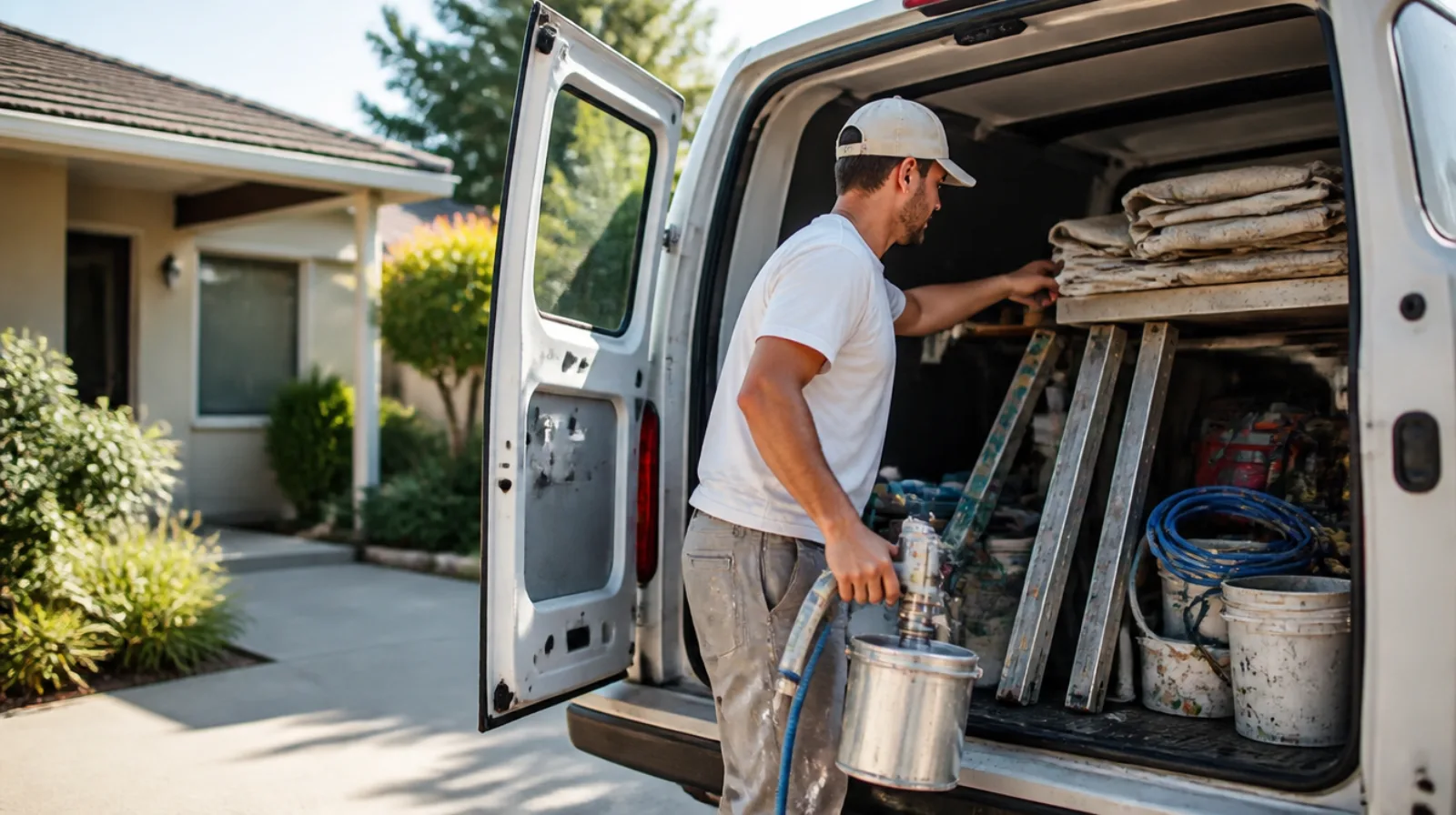
- An airless sprayer, once you have three or more exterior jobs booked to justify the cost and the extra masking time.
- Scaffolding or lift equipment, once you regularly take larger commercial or multi-story work.
- A second vehicle or trailer, once one truck cannot keep up with your schedule.
Most new owners spend $500 to $2,500 on tools and supplies to get started, then upgrade as revenue comes in. Buying a sprayer or scaffolding too early ties up cash you need for insurance and lead certification.
Price your work
One professional answering a student on CareerVillage put average paint pricing at 75 cents to $1.50 per square foot, with $1.35 as the national average. That is one person's figure, not an industry benchmark, and the answer does not say she paints for a living. Treat it as a sanity check. Your price has to cover paint and materials at today's cost, your labor, your overhead, your drive time, and the certification and insurance costs above. Then add profit. Housecall Pro puts typical painting profit margins at 15 to 45 percent. ClockShark says painting projects can earn 30 to 40 percent, against a standard construction margin of 1.5 to 2 percent. Use our painting estimate template so every quote is built the same way.
The real competition: unlicensed lowballers
Here is what the blogs do not say. This part is our own read, not a survey. Painting has one of the lowest barriers to entry of any trade, so anyone with a ladder can quote your job. Whoever skips the license, the insurance, and the lead certification carries none of those costs, and can always go lower than you. One painter in that r/paint thread put the new-business problem plainly: you have to be dirt cheap to get any work at the start, and you pay more for paint than competitors who have been around a while. So do not try to win on price. Win on the part that is hard. Another painter, 15 years in, said some paint jobs are 90 percent prep: cleaning, sanding, scraping, taping, plastic. Prep judgment, not brush technique, is what a homeowner pays a licensed, insured painter more for.
Get your first jobs
A website, a complete Google Business Profile, and referrals from your first few jobs do most of the early work. Before you spend money on ads, make sure every estimate goes out looking consistent. Put the scope and terms in writing with our painting contract template from your very first job, so there is no argument later about what was agreed.
Then answer the phone. A homeowner collecting quotes calls several painters, and 78 percent of customers hire the first business to respond. If you are up a ladder or driving between estimates, that call goes to voicemail, and the job goes to the next name on the list. A receptionist for painting calls like EveryDial answers every call in your business name and sends you the details. Run your own call volume through the missed-call cost calculator before you settle for voicemail.
EveryDial answers every call in your business name and sends you the details while you're on a ladder or between estimates. Plans start at $49 a month. Free to try.
Solo or hire? Decide on purpose
Most painting businesses stay one person for a while. Make that a choice, not a default. Solo means no payroll, no workers' compensation, and no crew to keep busy in a slow month. It also caps what you can book, and it is how owners end up owning a job instead of a business. Hiring changes your costs before it changes your income. Most states require workers' compensation once you have employees, and that sits inside the $2,000 to $7,000 insurance line above. Bringing in a subcontractor per job is the usual middle step. Pick which one you are aiming at, because it changes what you price and what you insure.
Watch your cash, not just your revenue
Painting has one real financial advantage. ClockShark notes that painters usually get paid soon after the job is done, unlike trades that wait on long construction schedules. That is not the same as safe. You buy paint before you get paid, winter is slow in most markets, and one unpaid invoice can stop you. Keep enough cash to cover a month of costs before you spend on more gear. If you do need money to start, the usual routes are a small business loan, an online lender, a personal loan, self-funding, or friends and family. Work those numbers first, in our guide on how to write a painting business plan.
Build from here
None of this has to happen at once. Get liability insurance first. Get your firm certification and renovator course done before your first pre-1978 job. Register your business. Stay inside your license threshold until you are ready for bigger work. The painting businesses that last treat the legal and financial basics as seriously as the paint job itself.
Frequently asked questions
How much does it cost to start a painting business?
Housecall Pro's line-item budget is headlined as [$3,000 to $15,000](https://www.housecallpro.com/resources/how-to-start-a-painting-business/), and its own items add up to $3,750 to $14,800: tools and supplies, licensing, a year of insurance, marketing, and basic operations. Narrower estimates around [$2,000](https://fundbox.com/blog/what-you-need-to-know-about-opening-a-house-painting-business/) usually assume you already own tools and skip a full year of insurance. For pre-1978 homes, add $300 for EPA firm certification plus the cost of an accredited renovator course.
Do I need a license to start a painting business?
It depends on your state, sometimes your county, and the size of the job. California requires a license once labor and materials on a job reach $1,000, and the exemption below that only holds if no building permit is needed and you hire nobody. Tennessee requires a Home Improvement license for residential jobs from $3,000 to $24,999, but only in the nine counties that adopted the law. Check your own state, then confirm whether it runs its own EPA-authorized lead-safe program.
How to be a self-employed painter?
Register as a sole proprietor or LLC, get general liability insurance, and get both EPA firm certification and certified renovator training before you work on pre-1978 homes above the small-area exemption. From there, most self-employed painters price by the square foot as a starting reference, adjust for their real costs, and build early jobs through referrals and a Google Business Profile rather than paid leads.
Do painters earn good money?
Painting businesses can be profitable: Housecall Pro puts typical profit margins at [15 to 45 percent](https://www.housecallpro.com/resources/how-to-start-a-painting-business/), and ClockShark says painting projects can reach [30 to 40 percent, against a standard construction margin of 1.5 to 2 percent](https://www.clockshark.com/blog/how-to-start-painting-company). Painters in that r/paint thread put the hard part in surface prep and in learning to price a job, not in paint application.
How to start a painting business with no money?
You cannot start with truly zero dollars, since insurance and, for pre-1978 homes, EPA certification and renovator training are real out-of-pocket costs. But you can start lean: use tools you already own, skip the sprayer and scaffolding until you have the job volume, register as a sole proprietor instead of paying LLC fees up front, and put your first dollars into liability insurance and certification instead of marketing.