
Contents
Key points
- A price per square foot means nothing until you say which square feet. A 14 by 14 room with 8 foot ceilings is 196 square feet of floor but 644 square feet of paintable wall and ceiling.
- The floor-to-surface multiplier is bigger on small rooms. About 4.2 times on a 10 by 10 room, about 2.9 times on a 20 by 15 room. That is why bathrooms and hallways lose money on a floor-area rate.
- One worked room, on one painter's rate card: $586 for wall and ceiling surface at $0.91 a square foot, $97 of trim, $190 of paint, $873 all in, and about $70 to $105 of net profit at the industry 8 to 12%.
- Repaint, new construction and commercial are three different rates. Commercial sits near $1 per square foot of surface, residential repaint at $2 to $6 with the basis usually unstated, and new custom builds at $10 to $15 per square foot of floor area.
- A cheap advertised rate is usually surface area, per coat, or labor only. And a price only earns money on jobs you win, because homeowners hire whoever answers the phone.
If you are writing a quote, painting cost per square foot is the number you need. It is also the slipperiest number in the trade. Ask ten painters what they charge per square foot and you get ten answers that are not measuring the same thing. Some mean the floor area of the house. Some mean the paintable wall and ceiling surface. On the same room those two numbers are more than three times apart.
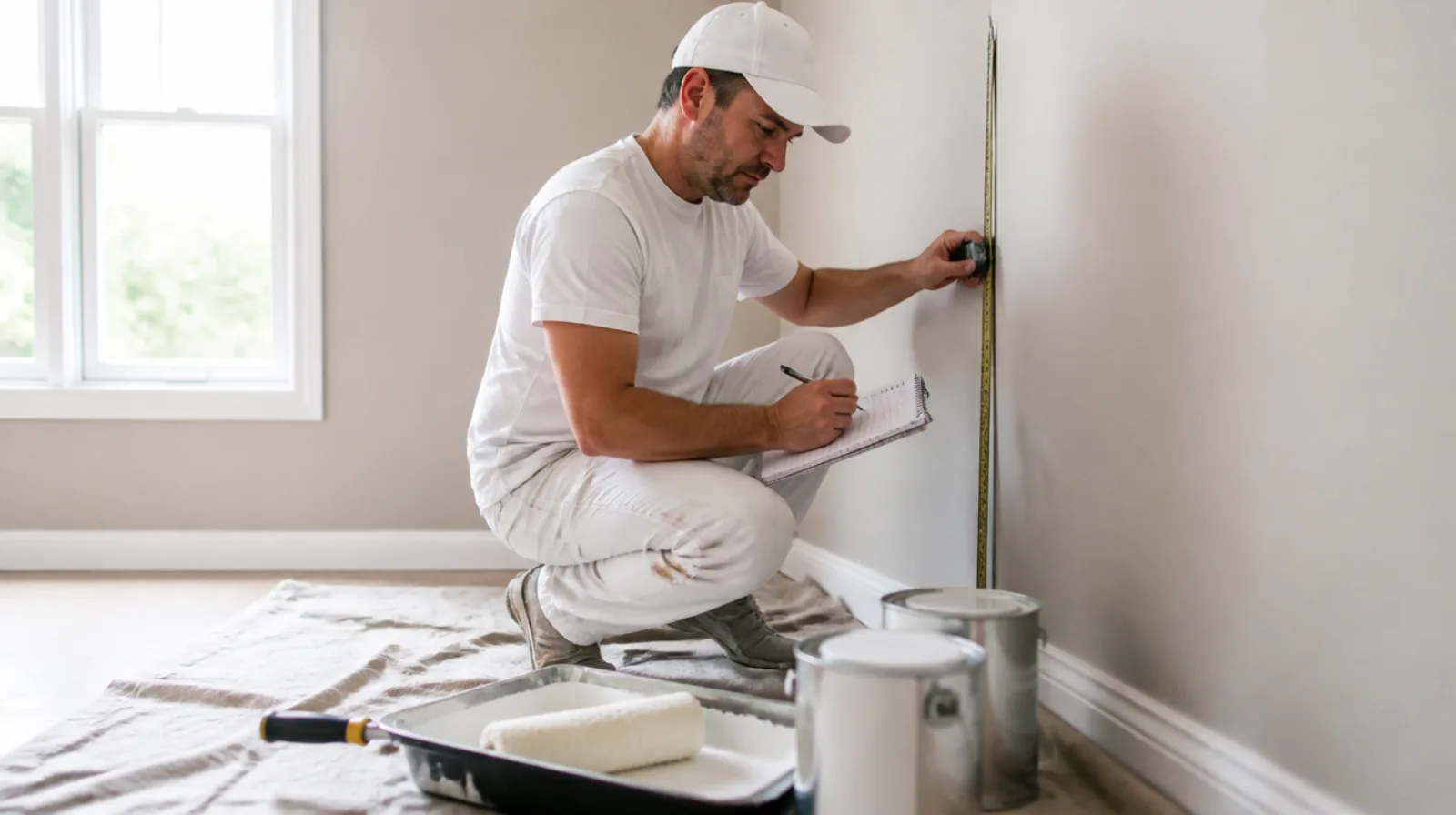
This guide is for the painter writing the quote, not the homeowner reading it. Wall feet versus floor feet comes first. Then the going rates, with a note on what each one measures. Then a worked room, from a gallon of paint to your profit, checked back against those rates.
Wall square feet or floor square feet?
Almost every published painting price is a dollar figure per square foot with no word on which square feet. That missing word decides whether your quote is right or off by a factor of three. Here is a real room, with numbers from a working painter.
Take a room 14 feet by 14 feet with 8 foot ceilings. Walls and ceiling both painted, two coats. One painter measured it out: that is 196 square feet of floor space, or 644 square feet of wall and ceiling. Same room. Two numbers. A 3.3 times difference.
The math is easy to redo on any room. Add the four wall lengths for the perimeter, then multiply by the ceiling height. Add the floor area if the ceiling is in scope. Here: 56 feet of perimeter times 8 feet is 448 square feet of wall, plus 196 of ceiling, so 644.
The multiplier is not the same for every room
Plenty of painters carry one rule of thumb, something like multiply the floor area by three. It is close on a mid-size room and badly wrong on a small one. Small rooms hold more wall per square foot of floor. Same math on a few sizes, walls plus ceiling, floor area first.
- 10 by 10 with an 8 foot ceiling: 100 floor, 420 surface. 4.2 times.
- 12 by 12 with an 8 foot ceiling: 144 floor, 528 surface. 3.7 times.
- 14 by 14 with an 8 foot ceiling: 196 floor, 644 surface. 3.3 times.
- 14 by 14 with a 10 foot ceiling: 196 floor, 756 surface. 3.9 times.
- 20 by 15 with an 8 foot ceiling: 300 floor, 860 surface. 2.9 times.
This is why bathrooms and hallways bleed money on a floor-area rate. They are small, so the multiplier is high, and they are packed with cutting in and trim. One painter warns that bidding from square footage and photos badly under-bid exactly those rooms on a job of his.
Why the same trade uses both conventions
This is not sloppiness. Some painters price interiors one way and exteriors the other on purpose. One painter describes his own company rule: exteriors get measured and priced by wall area, interiors by floor square footage. On an exterior you can see and measure the walls. On an interior, floor area is the one number a homeowner already knows.
Either convention works. Mixing them does not. Pick one for each type of work and put it in writing on the quote.
What the market charges per square foot
If you are working out how much to charge for painting, these ranges are a sanity check on your own math, not your price. Every line says what its number measures, or says the source never said.
- Interior painting cost per square foot runs an average of $2 to $6, depending on which parts of the interior are included. The source does not say wall or floor.
- By finish level, one contractor's table gives basic repaint at $2.00 to $2.75, standard finish at $3.00 to $4.25, and premium finish at $4.50 to $5.50 per square foot. Basis again unstated.
- Ceilings on their own run $1.50 to $3.50 per square foot. No ambiguity here, because a flat ceiling's area is its own footprint.
- A standard room comes to $400 to $900 on national average.
- Exteriors are quoted at $1.50 to $4 per square foot, with the average job at $3,177 and a range of $1,800 to $4,500. Basis unstated.
- One painter is clear about his basis: $0.91 per square foot of painted surface, which he says works out to about $3 per square foot of floor space, with trim at $0.60 per linear foot.
- In a high cost-of-living area, another painter puts interiors with 8 foot ceilings at $3 to $4 per square foot for primer plus two coats. He does not say wall or floor.
- Hourly, a professional painter typically runs $25 to $75 an hour. The narrower $35 to $60 band for most residential work is that contractor's own Kennesaw, Georgia market. By state, interior rates run from $30.67 to $60.61 an hour.
How to price painting jobs: paint, then the work
Now chain the pieces together. Almost no guide shows this end to end. Same 14 by 14 room: 644 square feet of wall and ceiling, two windows, two doors, two coats. One painter's rate card throughout, so nothing gets mixed.
The paint
Two coats over 644 square feet is 1,288 square feet of coverage. One gallon covers about 350 square feet. Divide 1,288 by 350 and you get 3.7, so buy 4 gallons. A gallon costs $20 to $100 depending on brand, quality and gloss level. At $35 a gallon that is $140. Add about $50 for tape, plastic, caulk and filler. Materials come to $190.
The price of the work
Use the rate card that names its basis: $0.91 per square foot of painted surface, and $0.60 per linear foot of trim. So 644 square feet of surface at $0.91 is $586. The same painter counts about 162 linear feet of trim in a 14 by 14 room with two windows and two doors, counting base, casing, door sides and window sills. At $0.60 that is $97. The work comes to $683, and he puts the same room at about $693 himself, so the arithmetic tracks his own quote.
He sets the room up with materials not included, so the $190 of paint goes on top. That is $873 for the room.
Check the number before you believe it
Most cost guides skip this step, and it is what catches a basis error. $873 over 196 square feet of floor is $4.45 per floor square foot, or $1.36 per surface square foot. That $4.45 sits inside the published $2 to $6, and the $873 sits at the top of the $400 to $900 a standard room is said to cost, fair enough with the ceiling, all the trim and the paint included.
The rate card checks out too. Run it on floor area instead: 196 square feet at his $3 per floor foot is $588, against $586 by surface. Two bases, same answer. That agreement is the test. If your surface rate and your floor rate disagree on the same room, one of them is wrong.
Now see what a slipped basis does. Put that $3 floor rate on the 644 square feet of surface and the room reads $1,932. The painter who ran that sum threw it out himself, saying he would love to be paid $2,000 for about four hours of work but that is not the job. A painter refusing to believe his own inflated number is the best proof that a rate without a stated basis is not a price.
Two checks before you send the quote
A quote can pass the math and still lose money. These two checks catch that.
Materials as a share of the price
One painter caps paint and consumables at no more than about 15% of the price, and nearer 10% on larger repaints. He applies it to a whole house: a $17,970 price, so $2,696 of materials at most. Our single room fails that test. $190 against $873 is 22%.
That failure is information, not an error. You buy whole gallons and a full set of tape, plastic and filler whether the room is small or large. That is the arithmetic behind a minimum charge. Run the 15% test on a whole house, not one bedroom.
One caveat on the 15%. A contractor breaking down a mid-range 1,500 square foot repaint puts materials at 20 to 30% of cost, labor at 55 to 70%, and overhead at 10 to 15%. That looks like a flat contradiction and it is not quite one. The 15% is a share of the price you charge. The 20 to 30% is a share of what the job costs you. Price carries overhead and profit too, so the same paint is a smaller slice of it. Run the number on your own last five jobs.
What is left for you
A common industry range for a painting contractor is 8 to 12% net profit, after labor, materials and overhead. On the $873 room that is roughly $70 to $105 in your pocket. If your own jobs land under 8%, the fix is usually the price, not the paint. Drop the finished number into our free painting estimate template and it is ready to send.
Three price tiers: repaint, new build, commercial
Same crew, same paint, three very different rates. The tier a job sits in moves your number more than anything else here.
Commercial repaint: the lowest rate
Big open walls, few obstacles, long runs. One commercial painter reports being around $1 per square foot of surface area. The rate is low because the work is fast and repetitive, and volume is what pays.
Residential repaint: the middle
This is most of the work and most of the published numbers. Roughly $2 to $6 per square foot, basis rarely stated. One painter gives his own all-in figure as about $5.50 per square foot for walls, ceilings and trim together, high-end paint included, and he means the floor footprint. He only uses surface area on exteriors. In the same comment he corrects the poster for mixing the two bases, then runs his own sum against the poster's wall figure. Even careful painters slip.
New construction: the highest
Empty house, nothing to mask, but far more surface to prime and caulk and a higher standard of finish. Painters quote this on the home's floor square footage. One reports a base of $10 per square foot on an average new construction custom home. Another doing high-end builds of 8,000 square feet and up reports $15 per square foot. Allow for the time as well: new construction wants about 30% longer for priming and caulking of walls.
Interiors can take 2 to 3 times as many labor hours as the same exterior square footage, because of the prep and the cleanup. Price both off one rate and that gap is where the loss hides.
Why a 99 cent per square foot ad is not what it looks like
You will see a competitor advertise $0.99 per square foot and wonder how anyone lives on it. Usually nobody does, because the ad is not measuring what a homeowner assumes.
One painter walks the trick through on a single 2,400 square foot house. Charge $0.99 for walls and ceilings, count priming the garage, and you are at $12,000. Then say the $0.99 buys one coat only, and two coats is $24,000. Then say the rate is labor only, and it pushes $30,000. Three moves, one house, one advertised rate.
The homeowner does simpler math. 2,400 times $0.99 is $2,376. The first step on its own is about five times that, before the per-coat move and the labor-only move go anywhere near it.
One painter in that thread calls it a race to the bottom, and several say the undercutting damages the whole local market. The lesson is simple. Never match an advertised rate until you know what it measures. On your own quotes, spell out the basis, the coats, and whether paint is included.
The step that decides if your price earns anything
A price only earns money on jobs you win. You measure the walls, do the math, send a fair quote. Homeowners call several painters and usually hire whoever picks up. If your phone goes while you are up a ladder, that careful pricing books a job for someone else.
EveryDial answers your phone and books the job when you cannot pick up, so the quotes you priced properly turn into paid work. Starter is $49 a month with 100 receptionist minutes and Pro is $149 with 400. Minutes past your plan bill per minute at a published rate, and a spending cap stops the bill running away. Our missed-call cost calculator puts a number on what those unanswered callbacks cost you in a month.
EveryDial answers and books the job while you are up the ladder. Free to try.
Once the price is agreed, put the terms in writing with our free painting contract template. Our painting business plan guide shows where pricing fits next to your overhead and your first-year targets.
Frequently asked questions
How much should I charge to paint per square foot?
It depends entirely on which square feet you mean. Published interior rates sit around $2 to $6 per square foot without saying wall or floor, while one working painter charges $0.91 per square foot of painted surface, which he says works out to about $3 per square foot of floor space. Pick one basis, price walls, ceilings and trim as separate lines, and write the basis on the quote. Then check the result against your own costs, not against the published range.
How much would a painter charge to paint a 12x12 room?
The national average for a standard room is $400 to $900. Measured out, a 12 by 12 room with 8 foot ceilings has 384 square feet of wall and 144 of ceiling, which is 528 of surface. At one painter's $0.91 per square foot of painted surface that is about $480, which sits inside the average. That figure covers walls and ceiling only, so trim, doors and paint are separate lines on top.
How long does it take a professional painter to paint a 12x12 room?
No cost guide publishes an honest production rate, so time your own crew on the next three rooms and use that. What is published is relative: interiors can take 2 to 3 times as many labor hours as the same exterior square footage, and new construction wants about 30% longer for priming and caulking. Use those multipliers to adjust the rate you measure. Your own timed number beats any published one.
How much should I pay a painter per day?
A professional painter typically runs $25 to $75 an hour, and one Georgia contractor puts most residential work in his own market between $35 and $60. By state, interior painting rates start at $30.67 an hour and reach $60.61. Over an eight hour day that is roughly $245 to $485. If you are subbing work out, agree the rate and the daily hours in writing before the first day.
How much should it cost to paint the exterior of a 2000 square foot house?
Exteriors are quoted at $1.50 to $4 per square foot, which on 2,000 square feet gives $3,000 to $8,000. The same source puts the average exterior job at $3,177 with a range of $1,800 to $4,500, and those two numbers do not line up. That is because the per-square-foot figure never says whether it means floor area or wall area. Measure the actual wall surface and price from that.