
Contents
Key points
- A square is 100 square feet of roof. Multiply any per square foot price by 100 to get the price per square, which is the unit you bid in.
- Add the 15 percent waste factor to material only. Multiply the footprint by the pitch factor to get real roof area, so a 6/12 roof is 1.118 times its footprint.
- Worked bid: a 23 square job with $400 a square of cost becomes a $14,200 bid at a 35 percent margin, or $617 a square.
- Markup is not margin. Adding 35 percent to your cost leaves you a 26 percent margin. Divide cost by 0.65 instead.
- The 25% rule starts in the Florida code. Repair more than a quarter of a roof section in 12 months and the whole section has to meet current code.
If you run a roofing company, roofing cost per square foot is the wrong unit to price in. It is the unit your customer uses, because every cost guide online is written for homeowners. You still need to know those numbers cold. But your bid gets built in squares, on measured roof area, with waste and pitch and margin on top. This page covers both, and the arithmetic that connects them.
Below you will find the market ranges converted into per-square numbers, the two adjustments that change your material order, and one worked bid that runs from a cost stack to a price you can defend. There is also a plain explanation of the 25% rule, which decides whether a damaged roof is a repair job or a full replacement.
Price by the square, not the square foot
A square is 100 square feet of roof. It is the unit shingles are sold in and the unit crews get paid in. Your roofing price per square is the number that tells you whether a job actually paid. When another roofer says a job went for $700 a square, that is the figure worth comparing yours to.
Almost every page ranking for these searches prices in dollars per square foot instead. That is not wrong, it is just aimed at the homeowner. The conversion is easy. Multiply a per square foot price by 100 to get the price per square, and divide by 100 to go back. So $6.50 a square foot is $650 a square.
The trap is not the arithmetic. It is what the number is measured against. A price per square foot can mean roof area or house footprint, and those stop being the same number the moment the roof has any pitch. Ask which one a quoted figure uses before you hold it up against yours.
What the market pays, in both units
Roof replacement cost per square foot is what a customer will quote back at you, so know these ranges. The per-square conversion sits beside each one, because that is what you bid in. Treat all of it as a sanity check, never as your price.
- The national average to install an asphalt shingle roof starts at $5.09 to $6.66 per square foot. That is $509 to $666 a square.
- A full asphalt shingle replacement runs about $5.50 to $10 per square foot of roof area, or $550 to $1,000 a square.
- One editorial guide puts total installed replacement at about $4 to $11 per square foot, which is $400 to $1,100 a square. That low end is why homeowners think you are expensive.
- In Florida, asphalt shingles get quoted at $4.50 to $8.00 and up per square foot, so $450 to $800 and up a square.
- In California, asphalt shingles run $6 to $12 per square foot, or $600 to $1,200 a square.
- In Minnesota, standard asphalt is quoted at $4.25 to $6 per square foot and architectural at $6 to $9. That is $425 to $600 and $600 to $900 a square.
- By material, one calculator lists asphalt at $3.40 to $5.95, tile at $6.30 to $12.30, metal at $6.00 to $24.50, and slate at $23.49 to $31.77 per square foot. Multiply each by 100 for the per-square version.
One warning about the very low numbers. A figure like $120 to $180 per square for architectural shingles sits on the same page as a $550 to $1,000 a square installed range. Both are real. One is the shingle line and one is the finished job. When a customer waves a cheap number at you, find out which of the two they are holding.
The cost stack, and where labor really sits
Three lines make up almost any tear off and replace job: material, labor, and removal with disposal. Published component figures give you a starting shape. One calculator splits a job into $3.75 per square foot of material, $2.25 of labor, and $1.25 of tear-off. Tear-off on asphalt gets quoted elsewhere at $0.39 to $0.53 per square foot, rising to $1.97 on tile.
You will also read that labor is 60 percent of the total cost of a roof replacement, or 40 to 60 percent of most roofing quotes. Read those carefully. They lump everything that is not material into labor, including overhead and profit. Your crew cost on its own is nowhere near 60 percent of a healthy bid. If it is, the bid is too low.
Waste factor and pitch: the two numbers that move your order
Before any money math, the area has to be right. Two adjustments do that job, and homeowner cost pages barely mention either one.
The 15 percent waste factor
You never order exactly the roof area. Cuts, overlaps, ridge caps, and valleys eat material. The standard add is 15 percent on material quantities. A cut-up roof with many valleys takes more. Waste applies to material only, because nobody pays your crew to install the offcuts.
The pitch multiplier
A roof seen from above is smaller than the roof itself. There is a formula behind the correction, but in practice you look the number up: 2/12 is 1.014, 4/12 is 1.054, 6/12 is 1.118, 8/12 is 1.202, and 12/12 is 1.414. Multiply the footprint by that number to get real roof area. A 12/12 roof is 41 percent more roof than the footprint suggests, before you charge a cent extra for the danger.
A worked bid, step by step
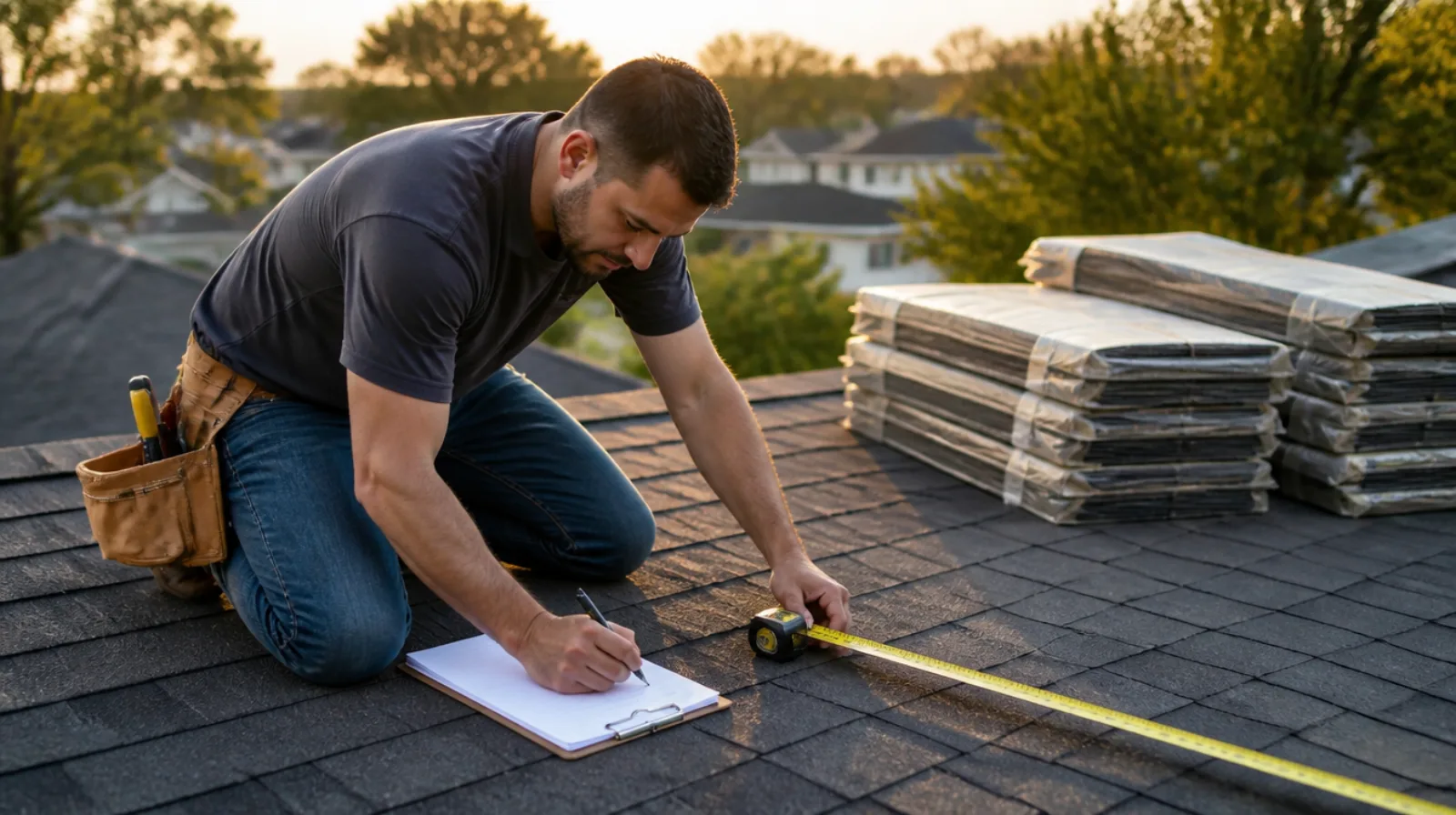
Here is one full bid on a real-sized roof. The market figures above are cited. The cost inputs are ours, picked to be realistic for a small crew, and you should swap in your own. The job: a single story house, 2,000 square feet of roof footprint, a 6/12 pitch, one layer of old asphalt coming off, architectural shingles going on.
Step one: footprint to squares
The pitch factor at 6/12 is 1.118. So 2,000 square feet of footprint is 2,236 square feet of roof. Divide by 100 and you have 22.36 squares. Round up to 23 squares. That is your bid area for labor and tear-off.
Step two: material, with waste
Add the 15 percent waste factor to the area, not to the money. 23 squares times 1.15 is 26.45, so you order 27 squares of material. Our input for material is $175 a square delivered, covering shingles, underlayment, drip edge, ridge cap, and nails. That is 27 times $175, or $4,725.
Step three: labor and removal
Labor and tear-off get paid on the real 23 squares, not the 27 you ordered. Our input for crew labor is $110 a square, so $2,530. Tear-off and disposal, dumpster included, is $85 a square, so $1,955.
Step four: your job cost
Add the three lines. $4,725 plus $2,530 plus $1,955 is $9,210. Divide that by your 23 squares and your cost is about $400 a square. Note what has not been paid yet: your truck, your insurance, your phone, your advertising, and you.
From cost to bid: markup is not margin
This is where roofers quietly lose money. Add 35 percent to your cost and $9,210 becomes $12,434. But the margin on that bid is only 26 percent, because markup is measured on cost while margin is measured on price. To actually keep 35 percent, divide the cost by 0.65. That is $9,210 divided by 0.65, or about $14,200. Your bid is $14,200, which works out to $617 a square.
Now check it against the market. $617 a square is $6.17 per square foot of roof, which sits inside the $5.50 to $10 range above, near the bottom. Told the homeowner's way it is $7.10 per square foot of house, since the footprint is 2,000 square feet. Both numbers are true, and you want both in your head before that conversation starts. Drop the finished figure into our free roofing estimate template and it is ready to send.
The 25% rule, and when a repair becomes a replacement
This one sits in the People Also Ask box on almost every roofing search, and almost nobody answers it plainly. It starts in the Florida Building Code, Existing Building, section 706.1.1. The code text reads: "Not more than 25 percent of the total roof area or roof section of any existing building or structure shall be repaired, replaced or recovered in any 12-month period unless the entire existing roofing system or roof section is replaced to conform to requirements of this code."
In plain terms: repair up to a quarter of a roof or a roof section within 12 months and you can just repair it. Go past a quarter and the whole roof, or that whole section, has to be brought up to current code. That is not a small line item. It is the difference between writing a patch and writing a replacement.
There is a large exception. Under Senate Bill 4-D, passed in 2022, a roof that was built, repaired, or replaced to the 2007 Florida Building Code or later, meaning work done on or after March 1, 2009, only needs the portion being worked on to meet current code. Insurance adjusters run the same test, and it is spelled out in an adjuster job aid for evaluating roof damage.
Two cautions before you use this. The rule starts in the Florida code, not in federal law. Other states and insurers echo the same 25 percent test, but the wording and the exceptions differ, so check your own state code and ask your insurer how they apply it. And measure before you quote: work out the damaged area as a share of the roof section, because that fraction decides which of the two bids you are writing.
What working roofers actually charge
Published ranges are wide and gentle. Roofers talking to each other are neither. In one r/Roofing thread on cost per square, roofers reported all-in prices of $650 to $900 a square in Illinois depending on pitch and whether it was one or two stories, $700 a square in rural New York, $650 a square in South Florida with double underlayment, and $550 to $750 a square in Southern California.
The same thread shows where the floor is. A roofer quoting $340 to $370 a square was told flatly that it was a hack price. A Michigan roofer with 20 years in the trade said he had been over $500 a square since 2010 and averaged around $650. Another roofer put the real limit simply: on a small job he would have to charge about $1,200 just to pay two men for a day, cover his overhead, and make a little profit.
That last one is the whole lesson. A day of crew time plus your overhead sets the floor under every bid you write. Material is the easy part. If a bid does not clear that floor, the job costs you money no matter how friendly the per square foot number looks.
The step that decides whether your price earns anything
Here is the part no cost guide covers. A price only earns money on jobs you win. You measure, you run the pitch and the waste, you land on $14,200, and you send it. Then the homeowner calls back with one question, or a hailstorm hits and forty people dial at once. If those calls go to voicemail while you are on a roof, your careful bid just handed the job to the next roofer in the search results.
That gap is what EveryDial closes. Your receptionist answers, takes the address and the problem, and books the job when you cannot pick up. Starter is $49 a month with 100 receptionist minutes and Pro is $149 with 400. Minutes past your plan bill per minute at a published rate, and a spending cap keeps the bill from running away. Our missed-call cost calculator shows what the unanswered ones are worth in a month.
Your receptionist answers and books the job while you are on a roof. Free to try.
Once your number is set, put the job terms in writing with our free roofing contract template. If you are still building the business around these figures, our roofing business plan guide shows where pricing sits in a first-year budget.
Frequently asked questions
How much is 2000 square feet of shingles?
2,000 square feet of roof is 20 squares. Add the 15 percent waste factor and you order 23 squares of material. At $120 to $180 a square for architectural shingles, the shingle line comes to about $2,760 to $4,140. Watch the wording with customers, because 2,000 square feet of house is not 2,000 square feet of roof once pitch is counted.
What is the 25% rule for roofing?
It comes from the Florida Building Code, Existing Building, section 706.1.1. If more than 25 percent of a roof area or roof section is repaired, replaced, or recovered in any 12-month period, the whole roof or that whole section has to be brought up to current code. Since 2022 there is an exception for roofs built or replaced to the 2007 Florida code or later, meaning work on or after March 1, 2009, where only the worked area has to meet current code. The rule starts in Florida law, so check your own state code and your insurer before you quote a large repair.
Is $25,000 a lot for a new roof?
It depends entirely on how many squares are up there. At $650 a square, $25,000 buys about 38 squares, which is a big or steep roof rather than a small ranch. For context, one guide puts the average roof replacement at $9,500, with a range of about $5,800 to $46,000. When a customer calls your number high, show them the square count and the price per square instead of arguing about the total.
What time of year is the cheapest to replace a roof?
Late fall and winter are the slow season for most crews, so that is when homeowners come asking for a deal. Filling a slow month is your scheduling decision, not a discount you owe anyone. If you do drop the price, take it out of your margin on purpose and know the exact number. A better move is to hold your price per square and offer the off-season slot itself as the thing of value.
How much does it cost to replace a roof on a 2,200 square foot house in California?
Start by turning the house size into roof area. At a 6/12 pitch, a 2,200 square foot footprint is about 2,460 square feet of roof, or roughly 25 squares. California asphalt shingles get quoted at $6 to $12 per square foot, which puts that job at about $14,760 to $29,520, or $600 to $1,200 a square. Your own bid should still come from your cost stack, with that range as the sanity check.