
Contents
Key points
- Get certified and licensed first. You need EPA 608 to handle refrigerant, then a state HVAC license, which usually means years of supervised work and an exam. Rules change by state.
- Starting an HVAC business runs about $8,000 to $75,000 for most new owners. A lean owner-operator start sits near the low end, and a branded full-truck start runs higher.
- Buy only the tools each job needs. Finance the van and big equipment until the work pays for them.
- Price for profit and answer every call. In year one you are the tech and the front desk both, and every missed call is a job a competitor books.
This guide shows you how to start an HVAC business, step by step, with real costs. You need certification and a license, a legal business, insurance, tools, a van, and a way to get customers. The order matters, and so do the numbers. Below is the full path from working for someone else to running your own shop.
You do not need a business degree to do this. You need your EPA card and license, enough cash to cover the slow first months, and a phone that gets answered. We will walk each step in order, show a lean start and a full start budget, and share the real numbers the polished guides skip.
Step one: get certified and licensed
HVAC is regulated at two levels, and this comes first. The federal one is EPA 608. You cannot legally buy or handle refrigerant without it. There are four types: Type I for small appliances, Type II for high-pressure systems, Type III for low-pressure systems, and Universal for all three. Most owners hold Universal.
Beyond the EPA card, most states require an HVAC contractor license to run your own shop, and the rules change by state. In 10 of the 50 states, individual technicians must be licensed too, not just the business. As one state example, Texas offers a certification path after 24 months on the job, or 48 months of supervised experience before you can apply for the contractor license. Check your state board before you plan a launch.
The license is not just a formality. One HVAC owner on Reddit warned that most banks will not lend until someone on the ownership team holds a license, so sort the license out before you count on financing.
Step two: pick residential or commercial
Decide who you serve before you buy a single tool. Residential work means homes, repairs, replacements, and seasonal tune-ups. Commercial work means bigger jobs, rooftop units, stricter code, and longer payment terms, often with a different license. Most solo techs start residential because the jobs are smaller and the cash comes in faster. You can add commercial work later once you have a crew.
Step three: set up your business
Now make the business real on paper. Most HVAC owners form an LLC because it keeps personal money separate from business risk. Register the business with your state, get an EIN from the IRS for taxes, and open a business bank account. Keep business and personal money apart from day one. It makes taxes and bookkeeping far easier later.
Step four: get insured and bonded
Insurance protects you when a job goes wrong, and many states require it before they issue your license. Start with general liability and commercial auto for your van. Add workers' compensation once you hire help, and a surety bond if your state or a customer asks for one. Insurance and bonding for a new shop can run $2,000 to $10,000 a year, climbing as you add trucks and staff.
Step five: write a simple business plan
You do not need a thick document, but you do need the numbers on paper, especially if you want a loan. A short plan covers your services, your prices, your startup costs, and how long your cash lasts. Our HVAC business plan guide walks through each section with a worked first-year budget, so use that instead of building one from scratch here.
What it costs to start an HVAC business
Here is the part most guides gloss over: real numbers. Most published estimates put a new HVAC business at $10,000 to over $100,000, depending on your tools, vehicle, and how big you start. A commonly cited low-end figure of $3,000 to $12,000 assumes you already own a work vehicle. The common line items look like this:
- Licensing and certification: $500 to $5,000.
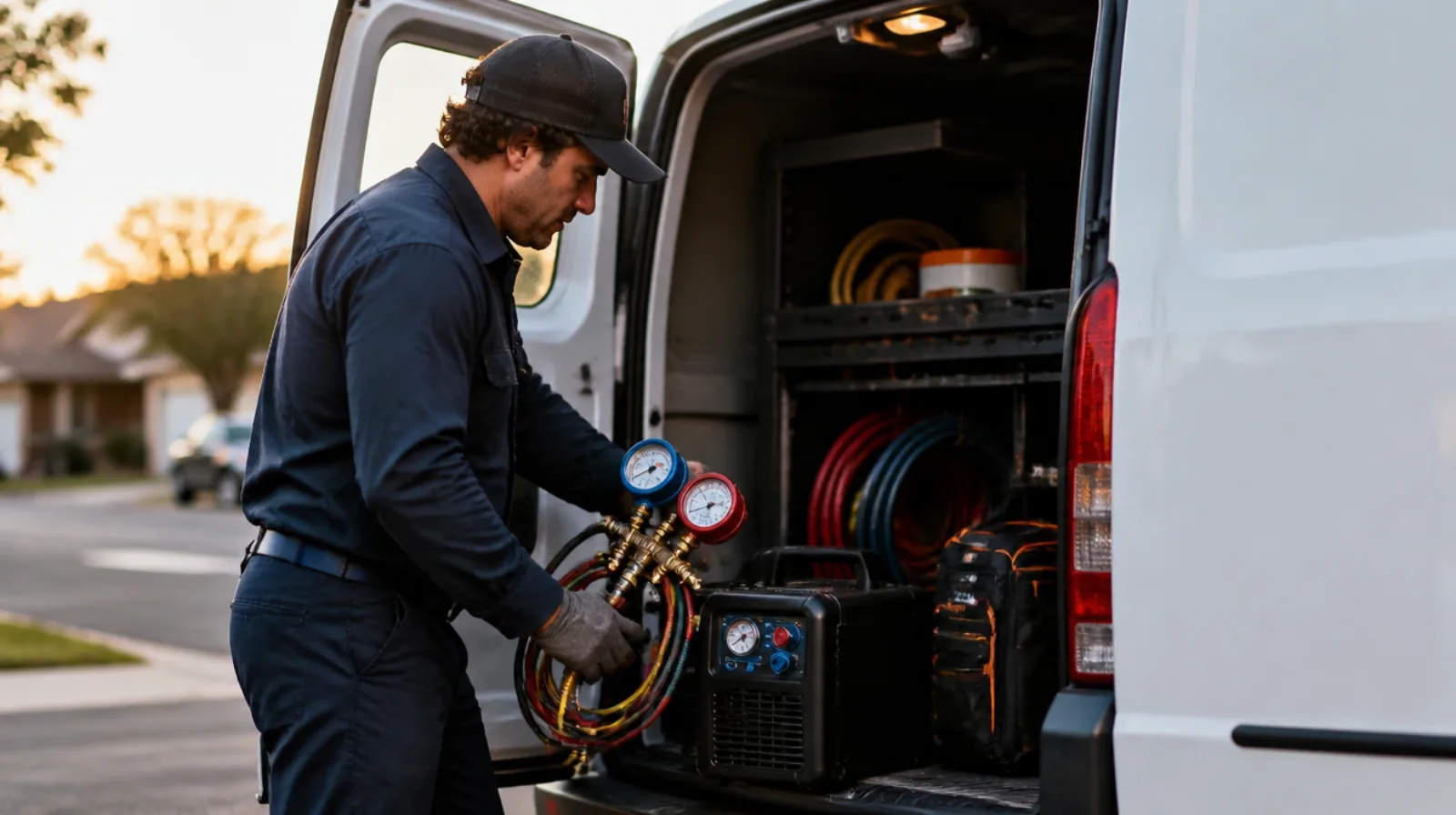
- Tools and equipment: $4,000 to $20,000, including gauges, a vacuum pump, and a recovery machine.
- Work van: $5,000 to $30,000, used or new, and usually your biggest single cost.
- Insurance and bonding: $2,000 to $10,000 a year.
- Marketing and website: $1,500 to $10,000.
- Starting inventory: $1,000 to $5,000 in common parts.
The lean owner-operator start
You keep your risk low. You work out of your own vehicle or a cheap used van, buy only the tools each job needs, and rent the expensive gear. This keeps you near the low end of the range. A rough budget to open:
- EPA cert and license setup: about $1,500
- Basic tools, gauges, and a recovery machine: about $4,000
- Used van, or your own truck: $5,000 or owned
- Insurance, year one: about $2,500
- Total to open: roughly $8,000 to $15,000
The full-truck start
You buy a proper work van, wrap it, stock a full tool set, and pay for marketing from day one. It costs far more, but you look established fast. Most new owners land somewhere in the middle.
- Full tool set and recovery equipment: $10,000 or more
- New or newer wrapped van: $25,000 to $40,000
- Insurance and bonding: about $4,000
- Marketing for year one: $8,000 or more
- Total to open: $50,000 to $75,000 or more
Tools, equipment, and your van
You do not need every tool on day one. Buy the tools your first jobs need, and add the rest as the work demands. Gauges, a vacuum pump, and a recovery machine are the core. Specialty tools like a nitrogen kit or a coil camera can wait until enough jobs pay for them, and van and equipment financing lets you spread the big costs over time instead of paying it all at once.
Set your prices before you take a job
Underpricing sinks new shops faster than a slow phone. Price every job to cover your costs, your overhead, and a real profit on top. On the segment level, service and repair often run 40 to 60 percent gross margin, while new installs run 20 to 35 percent, but only once your prices are right. Do not guess. Our HVAC pricing guide shows the exact math, from your true hourly cost to a flat price you can defend.
Get your first customers
You are certified, licensed, insured, and priced. Now the phone has to ring, and most of this is free. Set up a Google Business Profile, since it is how you show up when someone searches for HVAC repair near them. Ask every happy customer for a review and a referral. Word of mouth is the cheapest lead a new shop has, and it compounds.
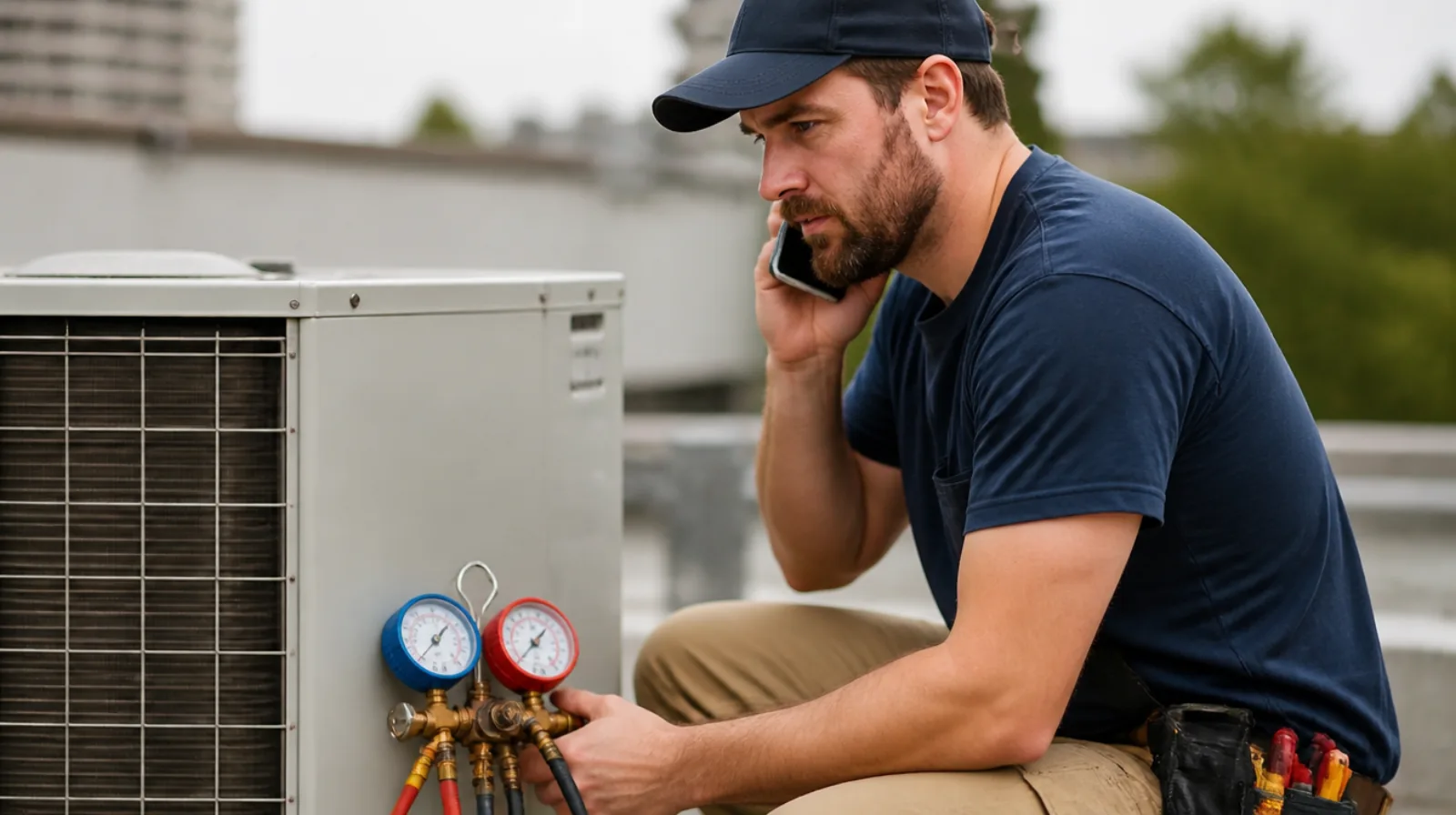
There is one leak that no amount of marketing fixes. In your first year you are on the roof or in the attic all day, with no office staff. Every call that rings out while your hands are full is a job a competitor books. As one HVAC owner put it on Reddit, owning the business is a completely different job than working in it, and cash flow, callbacks, scheduling, and steady leads are the real headaches, because "the trade work is only half the business." EveryDial answers every call and books the job when you cannot pick up, so the customers you worked to reach do not slip to the next shop. See what those missed calls are worth with our missed-call cost calculator.
EveryDial answers your phone and books the job when you're on a roof or in an attic. Free to try.
Keep the business running
The last step is the one that never ends: running the shop. Track your money with simple bookkeeping software, send clean invoices, and answer customers fast. Set aside cash for taxes every month. Honesty pays here too. One tech on Reddit noted that customers are less upset about the price than about the lying and upselling, so straight answers and a phone that gets answered win the repeat business. Lock your terms in writing with our free HVAC contract template and quote fast with our HVAC estimate template.
Frequently asked questions
How much does it cost to start an HVAC business?
Most published estimates run $10,000 to over $100,000, depending on the state and how big you start. A lean owner-operator start, using a cheap van and renting specialty gear, can open for roughly $8,000 to $15,000. A full-truck start with a new wrapped van and marketing from day one can run $50,000 to $75,000 or more. The biggest single swing is the van.
What license do I need to start an HVAC business?
You need EPA 608 certification to handle refrigerant, plus a state HVAC contractor license to run your own shop, which usually means years of supervised work and an exam. In 10 states, individual technicians must be licensed too. The exact rules change by state, so check your state licensing board.
Do I need EPA certification to start an HVAC business?
Yes. EPA 608 certification is federally required to buy or handle refrigerant. There are four types: Type I for small appliances, Type II for high-pressure systems, Type III for low-pressure systems, and Universal for all three. Most owners hold Universal.
Is owning an HVAC business profitable?
Yes, though usually not in year one. Well-run shops target 15 to 25 percent net profit, and service and repair carry higher gross margins than new installs. Year one is often lean while you build a client base, so plan a cash cushion for the slow first months.
Is it hard to start an HVAC business?
The trade work is the easy half. The hard half is running the business: cash flow, licensing, pricing, and answering the phone while your hands are full. Owners on Reddit are blunt that the trade work is only half the job, so plan for the office side from day one.