
Contents
Key points
- Most residential plumbers charge $80 to $130 an hour, with a service call fee of $75 to $150. After-hours work runs 1.5 to 3 times the standard rate.
- Your real hourly rate is built from your costs, not the market. Overhead, true labor cost, and profit all go into the number.
- A plumber's billable hours are only 40 to 50 percent of the workday. Price for the hours you can bill, not the hours you work.
- Flat rate is built from your hourly rate times the expected time, plus materials with a 40 to 60 percent markup.
- A price only earns money on jobs you win. The estimate goes out, the customer calls back, and the shop that answers gets the job.
This plumbing pricing guide is for the shop owner working out what to charge. Most residential plumbers charge $80 to $130 an hour, plus a service call fee to show up. But a market number is not your number. The rate that keeps your business alive comes from your own costs, not from what the plumber down the road charges.
Below you will find the two ways plumbers charge, the going rates and fees, and the math that turns your costs into a rate you can defend. There is one worked example that starts with a one-truck shop's real numbers and ends with a flat price for a water heater job. Then you will see how working plumbers actually set flat rates and mark up parts.
Hourly vs flat rate: how plumbers charge
There are two main ways to price a job. You bill by the hour, or you quote one flat price for the whole job. Most shops end up using a mix. Small, hard-to-guess jobs go hourly, and common jobs get a flat price. Here is how each one works.
Hourly (time and materials)
You charge for the hours you work plus the parts you use. It is simple and it protects you on messy jobs where you cannot guess the time. The downside is that the customer does not know the total until you are done, and some worry the clock is running slow on purpose.
Flat rate
You give one price for the job before you start. The customer knows the total up front, which builds trust and often wins the sale. You keep the reward for working fast. The risk is yours if the job runs long, so your flat price has to be built on honest time estimates.
One plumber on Reddit put the split plainly: small fixes are usually flat rate, and "many shops switched to flat rate because customers like knowing the total upfront." That is the trend. Flat rate for the common work, hourly for the unknowns.
What plumbers charge: rates and fees
Before you set your own price, it helps to know the going rates. These are the market ranges. Treat them as a sanity check, not a target. Your real rate comes from the math in the next section.
- Hourly rate: licensed plumbers charge $45 to $150 an hour, not counting materials or fees. Most residential shops sit at $80 to $130.
- By experience: a survey of over 30,000 customers put apprentice work at $45 to $90, journeyperson at $60 to $110, and master plumber at $80 to $200 an hour.
- By title, another guide lists a journeyman around $75, a master around $100, and emergency work around $150 an hour.
- Service call fee: most shops charge a call-out fee of $75 to $150 just to show up, with the full range running $50 to $200.
- After-hours and emergency: $150 to $300 an hour, or 1.5 to 3 times your standard rate.
- Small repairs: homeowners pay about $125 to $350 for small jobs like a clogged toilet or a leaky faucet.
The cost math: build your real hourly rate
Here is the part every guide buries under sales pitches. Your rate is not a guess. You build it from three things: your overhead, your true labor cost, and the profit you want on top. Get these right and the market ranges above will look about right too.
One trap sinks new shops. A plumber's billable hours are only 40 to 50 percent of the workday. The rest is driving, buying parts, quoting, and paperwork. So if you divide your yearly costs by 2,000 clocked hours, your rate will be too low to survive. You have to divide by the hours you can actually bill.
A worked example: from your costs to one job price
Let's build a real number for a one-truck shop. These are our own inputs, not a textbook. Say your yearly overhead is $90,000. That is your truck, fuel, insurance, phone, software, tools, and license. You clock about 2,080 hours a year, but you only bill 45 percent of them. That is 936 hours. Round it to 1,000 billable hours to keep the math clean.
Step one: overhead per billable hour
Take the $90,000 in overhead and spread it across the hours you can bill. That is $90,000 divided by 1,000 hours, or $90 an hour. Every billable hour has to carry $90 of overhead before you have paid yourself a cent.
Step two: your true labor cost
Say you pay yourself, or a tech, $40 an hour. That is not the real cost. Add payroll taxes of about 10 percent and benefits of about 15 percent. So $40 times 1.25 is $50 an hour. That is your true labor cost.
Step three: base cost, then profit
Add the overhead and the labor. That is $90 plus $50, or $140 an hour. This is your break-even. At $140 you cover your costs and earn nothing. Now add profit. A common target is a 40 to 60 percent gross margin. To keep it simple, add 20 percent on top of base cost: $140 times 1.20 is $168 an hour. That is your billable rate. For after-hours, times it by 1.5, which gets you to $252 an hour.
Step four: turn the rate into a flat price
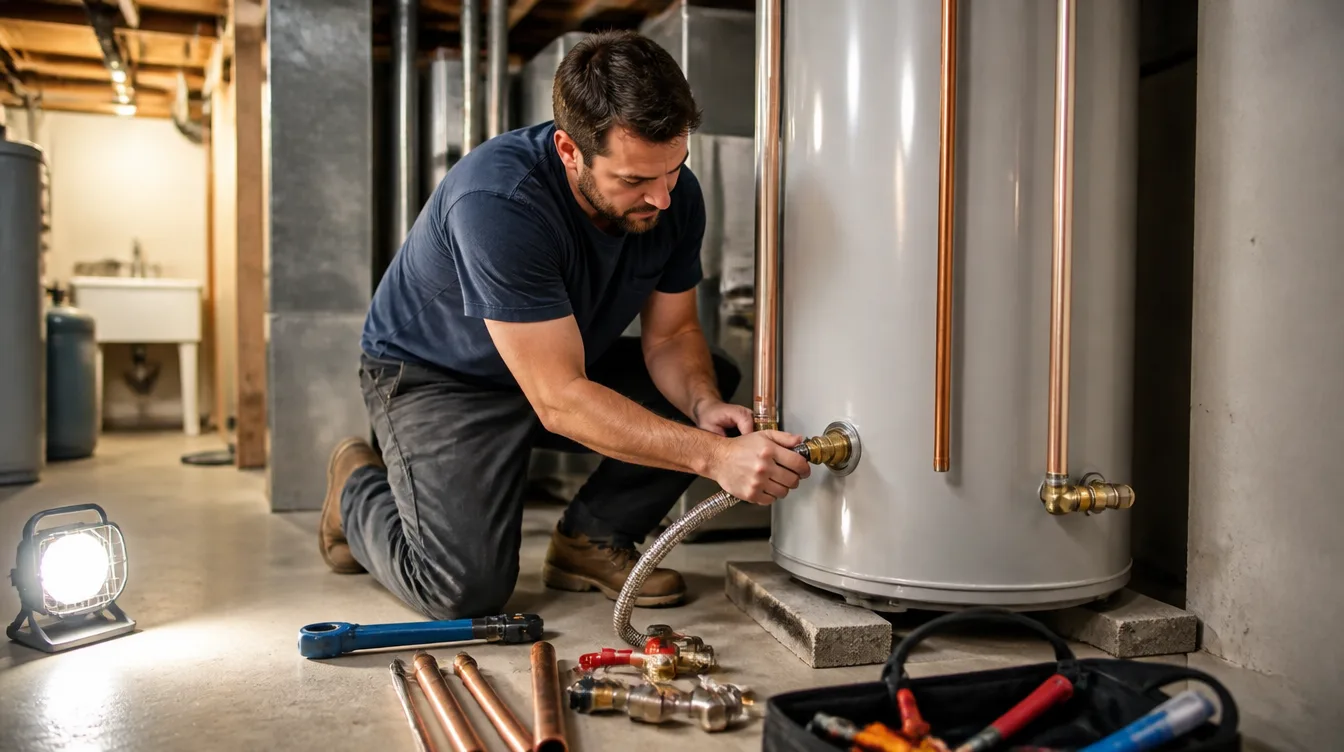
Now price one real job: swapping a 50-gallon water heater. From experience it takes about 3 hours. Labor is 3 times your $168 rate, or $504. The heater and fittings cost you $650. Mark parts up by 50 percent, so $650 becomes $975. Add labor and parts: $504 plus $975 is $1,479. That is your flat price, built from your own costs, not copied from anyone. Drop the final number straight into our free plumbing estimate template and it is ready to send.
Materials markup: what to add on parts
Parts are not sold at cost. You buy them, store them, warranty them, and stand behind them. Most plumbing shops apply a 40 to 60 percent markup on parts and materials. So a $100 part is billed at $140 to $160. That markup is not padding. It pays for the trip to the supply house and the risk if the part fails.
How working plumbers actually set prices
The formulas are clean, but the shop numbers are higher than people expect. One plumber on Reddit said their company rate is right around $350 an hour, because it covers far more than the plumber's wage. That covers the truck, the office, the warranty, and the slow days. The wage is a small slice of the rate.
On how to set flat rates, one plumber on Reddit laid out the exact method used above: figure out your needed hourly rate, then price everything flat rate based on the expected time per task, plus materials and markup. Another gave a quick rule for the hourly rate itself. Their labor rate is double what it costs to get the truck out, so if a truck costs $90 to send, they charge $180 an hour, and they mark materials up 1.4 to 1.5 times.
Their real-world job prices line up with the math too. Plumbers on Reddit report hourly rates around $100 to $160, small flat-rate fixes at $150 to $300, and any job that means opening walls or cutting pipe jumping fast to $300 to $600 or more. If your worked-out number lands near these, you are on solid ground.
When to raise your prices
Set your rate once and it goes stale. Parts cost more each year. Fuel and insurance climb. If your booked calendar is always full weeks out, you are too cheap and should raise your rate. Review your numbers at least once a year, and reprice when your costs move. A small yearly bump is easier on customers than one big jump every five years.
The step that decides if your price earns anything
Here is the part no pricing guide mentions. A price only earns money on jobs you win. You do the math, quote a fair flat price, send the estimate, and then the customer calls back to book. If that call goes to voicemail because you are under a sink, they dial the next plumber. Your careful pricing just booked a job for someone else.
This is the leak at the end of every quote. EveryDial answers your phone and books the job when you cannot pick up, so the estimates you worked hard to price actually turn into paid work. Before you touch your rates, make sure every caller gets an answer. Our missed-call cost calculator shows what those missed callbacks are worth in a month.
EveryDial answers and books the job when you can't pick up. Free to try.
Once your rates are set, lock the job terms in writing with our free plumbing contract template. If you are still building the business around these numbers, our plumbing business plan guide shows where pricing fits in your first-year budget.
Frequently asked questions
How to calculate the cost of plumbing?
Start with your yearly overhead and divide it by the hours you can actually bill, which is about 40 to 50 percent of your workday. Add your true labor cost, meaning your wage plus payroll taxes and benefits. That gives your break-even rate. Add 20 percent or more for profit to get your billable hourly rate.
What's the average price for a plumber to come out?
Most shops charge a service call fee of $75 to $150 just to show up, with the full range running $50 to $200. That fee is often separate from the labor once work starts. After-hours or emergency visits cost more, usually 1.5 to 3 times the standard rate.
How much should you expect to pay a plumber?
Licensed plumbers charge $45 to $150 an hour, and most residential shops sit at $80 to $130. Small repairs like a clogged toilet run about $125 to $350. Bigger jobs that mean cutting into walls or pipe can jump to $300 to $600 or more.
Should plumbers charge flat rate or hourly?
Most shops use both. Flat rate works best for common jobs, since the customer knows the total up front and it builds trust. Hourly is safer for messy jobs where the time is hard to guess. The trend is toward flat rate for everyday work because customers like knowing the price before you start.